Composite vs Wood Deck: Which Holds Up in Massachusetts Winters
A wood deck costs less to build but needs yearly care to survive freeze-thaw cycles and snow shoveling. Composite boards from Trex or TimberTech eliminate most of that labor and resist salt damage, though the upfront cost runs about twice as high. Here are the real differences over a 15-year span so you can pick the material that fits your time, budget and winter routine.

How does a Massachusetts winter punish a wood deck
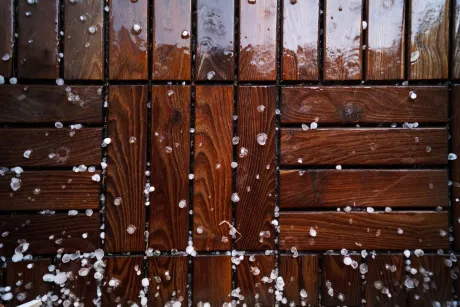
Wood absorbs water from melting snow, then that water freezes and expands inside the fibers. A single winter of 60 to 80 freeze-thaw cycles in central Massachusetts widens surface checks into deep cracks, especially around fasteners where water pools. Boards that looked tight in October can show quarter-inch splits by March.
Pressure-treated southern yellow pine moves aggressively with moisture swings. The soft earlywood between the grain lines erodes under snow shovels, leaving a washboard surface that holds ice-melt chemicals against the wood. Calcium chloride and rock salt draw more moisture into the cells, accelerating rot at the end grain of butt joints and stair treads where water has no way to drain.
Cedar resists rot better than treated pine but bruises easily. A metal shovel edge leaves gray gouges that darken over the season, and the softer wood compresses under heavy snow load, so shovel blades catch on raised grain instead of sliding cleanly. Trapped moisture under packed snow that sits for weeks promotes surface mold on cedar, turning a silver-gray deck blotchy black wherever the snow pile lingered.
Why composite boards handle snow, salt and ice better

A composite board has a dense, non-porous polyethylene shell fused around a wood-plastic core. This capstock layer, found on Trex Transcend and TimberTech AZEK lines, keeps meltwater from soaking into the board. Where a wood plank absorbs moisture and splits after a freeze-thaw cycle, a capped composite plank sheds the water before it can freeze inside the fibers.
Rock salt and calcium chloride de-icers eat into pressure-treated pine and leave cedar with a bleached, fuzzy surface after one winter. The capstock on a quality composite board resists that chemical attack and the scrape of a plastic snow shovel. You still want to avoid metal shovels with a sharp edge, but the shell holds its color and texture through repeated clearing.
Low water absorption also means the board does not swell and contract as much as wood when temperatures swing from 15 °F to 45 °F in a single week. Hidden fasteners let the board slide along the joist just enough to relieve that movement without pulling a screw head through the surface or popping a plug. For homeowners east of Worcester, an installer like UBrothers Construction, a composite deck builder in Framingham can set the gaps to the manufacturer's cold-weather spec so the deck stays flat through March.
What you pay per square foot installed: composite vs wood
In MetroWest Massachusetts, a pressure-treated pine deck typically runs $25 to $40 per square foot installed, including the frame, railings and stairs. Cedar adds a premium for the lumber itself, landing in the $35 to $55 range. A capped composite system like Trex or TimberTech, with a matching railing, generally falls between $45 and $70 per square foot installed. These spreads reflect the cost of materials, the complexity of the design and local labor rates, not just the board price.
Several factors push a project toward the higher end of those ranges. The labor premium for hidden fasteners is one of the biggest: the clip-and-screw system takes longer to install than face-screwing a wood board, and you pay for that time. A second-story deck with a staircase, a multi-level layout with angles, or any tear-down and disposal of an old structure also drives the total higher. For a straightforward ground-level rectangle, you can expect numbers near the bottom of each band.
- Pressure-treated pine: $25, $40 per sq ft installed
- Cedar: $35, $55 per sq ft installed
- Capped composite (Trex, TimberTech): $45, $70 per sq ft installed
- Second-story or multi-level designs add $8, $15 per sq ft for extra framing and stairs
- Hidden-fastener systems add $3, $6 per sq ft in labor over face-fastened boards
- Tear-down and disposal of an existing deck adds $4, $7 per sq ft
Maintenance hours and dollars over 15 years
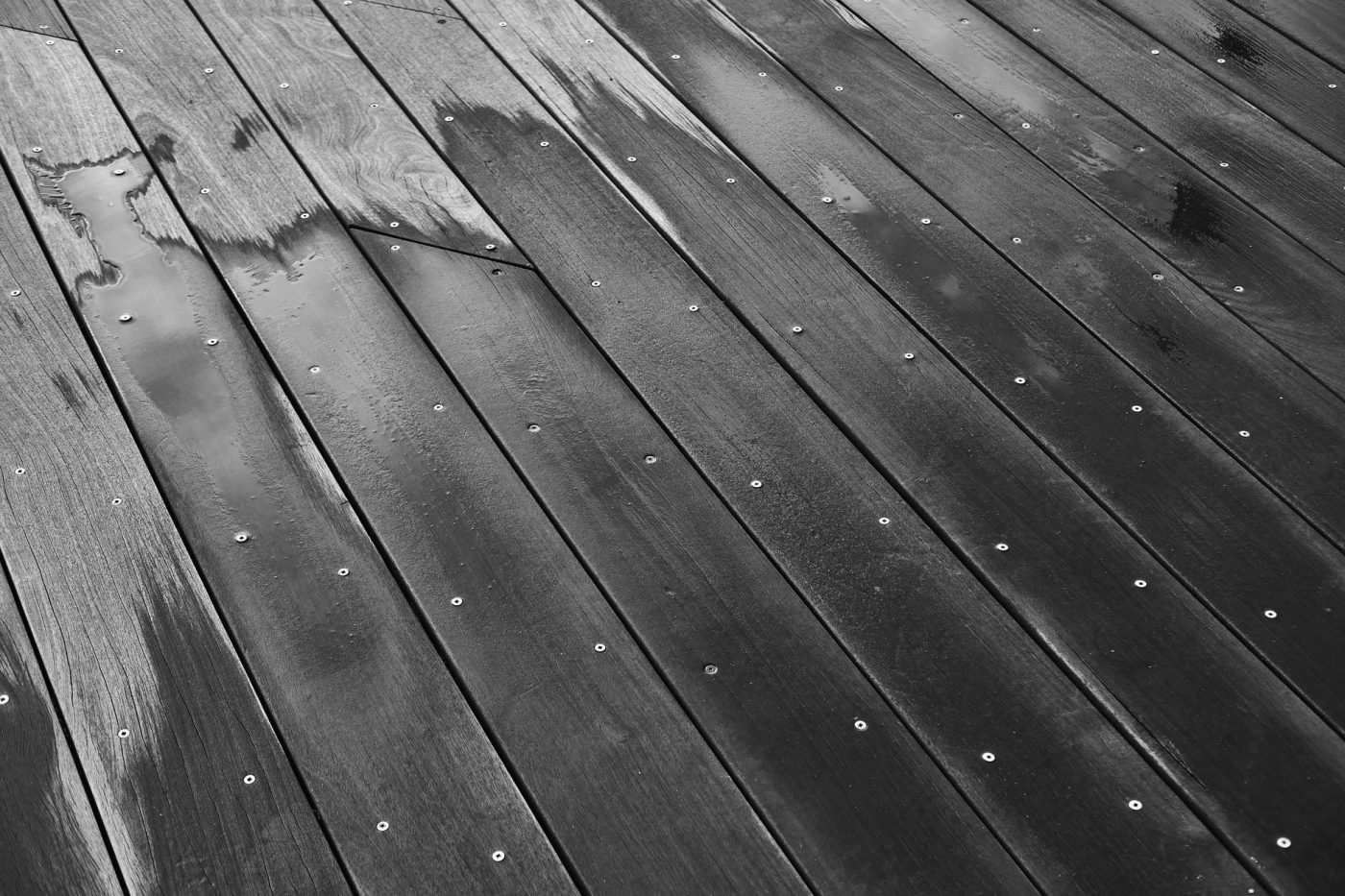
A pressure-treated pine deck in Massachusetts needs cleaning and a fresh coat of stain or sealer every year, sometimes every other year if you use a high-solids penetrating stain. Cedar holds up a little better but still calls for a re-coat every 2-3 years because freeze-thaw cycles crack the surface film faster than in drier climates. Figure four to six hours of labor per coat for a 300-square-foot deck, not counting the time you spend moving furniture and masking siding.
Composite boards skip the chemical routine entirely. You wash them with warm soapy water and a soft brush once or twice a season to lift pollen, salt residue and leaf tannins. No sander, no pump sprayer, no respirator, no weather window to watch. Over 15 years the hour count tilts heavily: maybe 90-110 hours of active upkeep for wood against 15-20 hours for composite, and that gap widens if you hire the work out at $45-65 an hour in MetroWest.
Board replacement adds another line to the wood column. Cupped, split or rotted deck boards are a fact of life after a half-dozen winters, especially where snow piles sit and melt. Swapping out a handful of 5/4×6 pressure-treated boards runs $80-140 in material and labor per board when done piecemeal. Composite boards do not cup or rot, so the only planned refresh is a deep clean and light sanding of any surface fuzz around year 12, a half-day project that costs under $100 in supplies.
How board gapping changes in cold weather
Composite decking expands and contracts with temperature far more than wood. On a 20-degree morning in January, the boards are at their shortest. By the time a July afternoon pushes the surface past 120 degrees, the same board can grow by a quarter inch or more along its length. Wood moves mostly with moisture, swelling across its width when wet and shrinking as it dries. Composite moves with heat, and the movement is predictable.
Manufacturers like Trex and TimberTech publish exact gap requirements for cold-weather installation. A typical spec calls for a 3/16-inch end-to-end gap when the temperature at installation is below 40 degrees, narrowing to 1/8 inch above 80 degrees. Side-to-side spacing between boards stays at roughly 3/16 to 1/4 inch regardless of temperature. Butt joints that look tight in February will close completely by August if the installer ignored the cold-weather numbers, causing the deck to buckle at the seams.
Pressure-treated pine shrinks as it dries over the first year, opening up gaps that were tight at installation. Cedar moves less but still cups and warps with moisture cycles. Composite does not shrink over time, so the gaps you set on install day are the gaps you live with. The risk is not boards pulling apart but boards pushing against each other when the heat returns.
Hidden fasteners and snow shoveling: what works
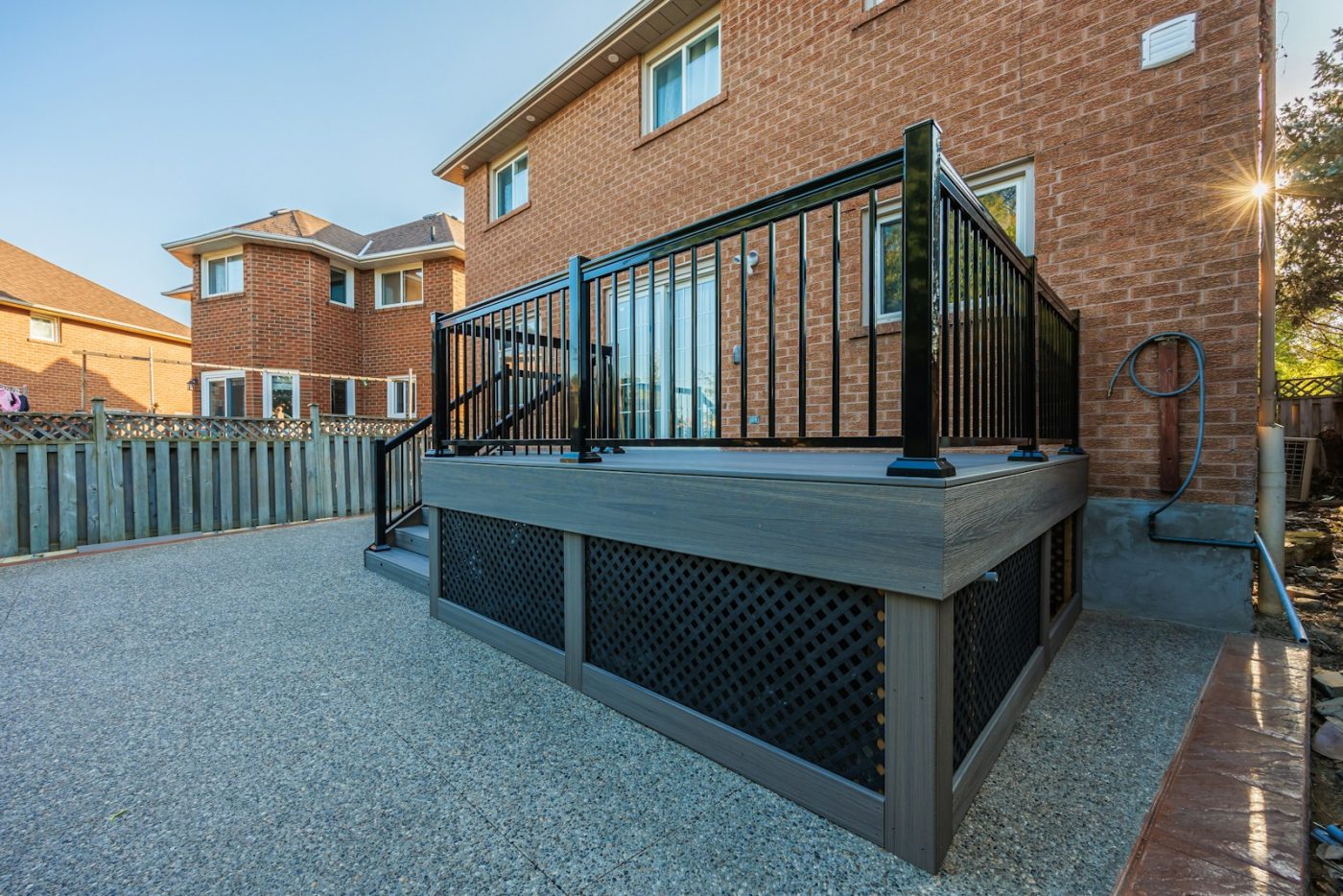
A deck with hidden fasteners gives you a smooth surface with no screw heads sitting proud of the board. That matters when you shovel snow because the blade of the shovel slides across the deck without catching on hardware. Face-fastened wood decks tend to chip around the screw holes over time, and a metal shovel edge will find every one of those spots.
Composite grooved-edge boards paired with plug-and-clip systems hold up well under repeated shoveling. The clip sits inside the groove below the board surface, so the shovel never touches it. Trex hidden fasteners and TimberTech CONCEALoc both work this way, and installers east of Worcester use them regularly for MetroWest homes. The groove itself stays clean if you leave the recommended 1/8 inch gap at the butt joints for drainage.
Even with a smooth composite surface, you still want a plastic shovel with a nylon wear strip on the blade edge. A metal shovel can gouge the board surface in very cold weather when the capstock gets brittle. The nylon strip wears down over time and is replaceable, and it will not leave gray scuff marks the way a bare metal edge does on lighter deck colors.
Is a composite deck worth the extra upfront cost
For a 320 sq ft deck in central Massachusetts, the math shifts in favor of composite by year 8 or 9. A pressure-treated wood deck runs about $5,000 to $7,000 installed, while a mid-range composite like Trex Select lands around $8,500 to $10,500. The gap looks wide until you add the costs that wood demands every spring.
Over 15 years, a wood deck needs staining or sealing every two to three years at $400 to $600 per application. You will also replace a handful of cupped or split boards after a few freeze-thaw cycles, a $300 to $500 repair. Composite skips all of that. A wash with soapy water once or twice a season is the only routine expense.
Here is how the numbers stack up for a 320 sq ft deck in MetroWest over 15 years:
- Pressure-treated wood installed: $6,000, plus seven seal-and-stain cycles at $500 each, plus one partial board replacement at $400, totaling roughly $9,900.
- Cedar installed: $9,000, plus the same seven maintenance cycles and one repair, landing near $12,900. Cedar looks handsome but softens fast under snow shovels.
- Trex Select composite installed: $9,500. Add two deep cleans at $150 each and the total stays under $10,000.
- TimberTech Legacy composite installed: $11,500, with the same minimal upkeep, bringing the 15-year figure to about $11,800.
- A wood deck in a shaded yard that stays damp into April will need an extra round of sanding and staining, pushing the wood total past the cost of a basic composite.
- Composite also avoids the annual ritual of sanding splinters before kids go barefoot, a time cost that does not show on an invoice but matters every June.
Composite costs more on day one and less every year after. If you plan to stay in the house beyond the next presidential election, the premium pays for itself in skipped weekends with a brush and roller. An installer familiar with cold-climate gapping and hidden fasteners can give you a line-item comparison that reflects local labor rates east of Worcester.
Frequently asked questions
Does composite decking get too slippery when it snows
Most capped composite boards have a subtle wood-grain embossing that provides traction comparable to wet wood. For extra grip in shady spots that stay icy, choose a board with a deeper grain profile or add grit-infused stair treads. A plastic shovel with a nylon wear strip clears snow without burnishing the surface smooth over time.
Will salt or calcium chloride stain a composite deck
Calcium chloride and rock salt can leave a white haze on any deck, but the non-porous capstock on Trex and TimberTech prevents the chemical from soaking in. Rinse the boards with a garden hose once the snow melts and the residue washes off. Wood absorbs the brine, which draws moisture and accelerates splitting around fasteners.
Can I install composite decking over my old wood frame
You can, provided the existing joists are level, free of rot and spaced no wider than 16 inches on center. Composite is heavier and more flexible than wood, so wider joist spacing causes a bouncy feel. Have a pro check the frame after a few Massachusetts winters; frost heave often shifts footings enough to throw joists out of plane.
How long does a composite deck last compared to pressure-treated pine
A capped composite deck typically lasts 25 to 30 years with basic cleaning, while a pressure-treated pine deck in Massachusetts often needs a full resurface or replacement between years 12 and 18. Cedar can reach 20 years if restained every other year, but hidden rot at joist contact points often cuts that short. The frame itself, whether wood or steel, determines the final lifespan of either surface.